Too Much Information by Cass R. Sunstein
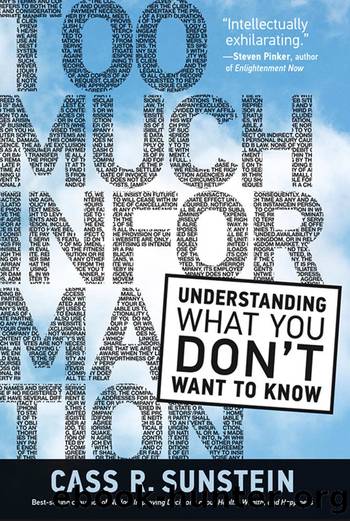
Author:Cass R. Sunstein [Sunstein, Cass]
Language: eng
Format: epub
Tags: mandatory labels; mandatory disclosure; conflict of interest; welfare; well-being; behavioral science; behavioral economics; psychology;
ISBN: 9780262044165
Publisher: MIT Press
Published: 2020-08-07T00:00:00+00:00
Mass Atrocities and Consumer Choices
In the Dodd-Frank Act, Congress required the Securities and Exchange Commission to issue regulations requiring firms to disclose their use of conflict minerals, which are minerals mined in the DRC and other countries where armed groups fund themselves by managing and extorting mining operations.13 The SEC issued those regulations, which were challenged in court by the National Association of Manufacturers (NAM). Among other things, NAM argued that the regulations were arbitrary and capricious under the Administrative Procedure Act because the SEC did not conduct an adequate cost-benefit analysis. Although the SEC calculated the cost of the regulations to industry, it did not estimate the benefits of the regulations, on the ground that it was not feasible to do so. The court rejected NAMâs argument that the agencyâs analysis was legally insufficient.14
The SEC concluded that the disclosure regime would impose a one-time cost of $3 to $4 billion on industry and another $207 to $609 million per year.15 At the same time, the SEC explained that it was âunable to readily quantifyâ the benefits.16 The principal reason did not involve translating the relevant benefits into monetary equivalents; it involved the difficulty of knowing what the benefits might be even before monetization was ventured.
The SEC thought that it was impossible to know whether disclosure would reduce violence in the DRC, and if so, by how much. The chain of causation was long and complex: (1) consumers would need to read or learn about the disclosures; (2) this information would need to cause them to reduce their purchases from firms that use conflict minerals; (3) the reduction in demand would need to be sufficient to cause firms to switch to suppliers of nonconflict minerals; and (4) the loss in revenue to armed groups in the DRC would need to cause them to lay down their arms and negotiate peacefully. If (4) happened, or something close to it, we would need to know what would happen on the ground. With all that in mind, the SEC concluded that any effort at quantification would be doomed to failure. As a matter of law, it emphasized that Congress had mandated its action and thus, in effect, determined that the benefits were sufficient by enacting the law.
The court upheld the agencyâs decision.17 In the courtâs view, the regulation was not required to pass a cost-benefit analysis because Congress required the agency to act whatever the outcome of that analysis. In any case, the agency did not act arbitrarily in concluding that the moral value of the regulation could not be quantified and put in monetary terms. The court added: âEven if one could estimate how many lives are saved or rapes prevented as a direct result of the final rule, doing so would be pointless because the costs of the ruleâmeasured in dollarsâwould create an apples-to-bricks comparison.â18
The court was surely on solid ground when it held that the SEC did not act arbitrarily in concluding that it could not estimate the benefits for people living in the DRC.
Download
This site does not store any files on its server. We only index and link to content provided by other sites. Please contact the content providers to delete copyright contents if any and email us, we'll remove relevant links or contents immediately.
The Brazilian Economy since the Great Financial Crisis of 20072008 by Philip Arestis Carolina Troncoso Baltar & Daniela Magalhães Prates(351597)
International Integration of the Brazilian Economy by Elias C. Grivoyannis(111541)
The Art of Coaching by Elena Aguilar(53585)
Flexible Working by Dale Gemma;(23349)
How to Stop Living Paycheck to Paycheck by Avery Breyer(19824)
Thinking, Fast and Slow by Kahneman Daniel(12500)
The Acquirer's Multiple: How the Billionaire Contrarians of Deep Value Beat the Market by Tobias Carlisle(12421)
The Radium Girls by Kate Moore(12159)
The Art of Thinking Clearly by Rolf Dobelli(10687)
Hit Refresh by Satya Nadella(9236)
The Compound Effect by Darren Hardy(9133)
Tools of Titans by Timothy Ferriss(8567)
Atomic Habits: Tiny Changes, Remarkable Results by James Clear(8487)
Turbulence by E. J. Noyes(8181)
A Court of Wings and Ruin by Sarah J. Maas(8081)
Change Your Questions, Change Your Life by Marilee Adams(7912)
Nudge - Improving Decisions about Health, Wealth, and Happiness by Thaler Sunstein(7833)
How to Be a Bawse: A Guide to Conquering Life by Lilly Singh(7597)
Win Bigly by Scott Adams(7318)
